
What Social Entrepreneurship Actually Is

Social entrepreneurship is building a business that solves a social problem as its primary activity, not as a side project. The revenue model and the social mission are the same thing. If the business stopped making money, the social impact would stop too, and vice versa.
That distinction matters. A company that donates 5% of profits to charity is not a social enterprise. That’s a regular business with a CSR programme. A social enterprise is one where the product itself addresses a social problem: a company that employs long-term unemployed people, a service that delivers clean water to areas without it, a platform that connects smallholder farmers directly to buyers.
The term gets stretched to cover everything from Patagonia’s environmental commitments to a local bakery that hires people with disabilities. That stretching makes the term less useful. For this article, I’m using the narrower definition: businesses where the social mission is baked into the operating model, not bolted on afterwards.
Why It Matters More Now Than Before
Three things have changed in the last decade that make social entrepreneurship more viable and more necessary than it was for previous generations of founders.
Consumers expect it
Consumer research consistently shows that a majority of buyers now factor sustainability and social impact into purchasing decisions, with a significant minority willing to pay a premium for it. That’s not a niche. That’s most of your addressable market factoring social and environmental impact into whether they buy from you.
For a new business, this means the social mission isn’t a marketing expense. It’s a competitive advantage. Companies that launch with the mission embedded attract customers who’d have to be convinced to care about it if it came later.
Talent expects it
The people you want to hire, particularly the ones early in their careers, increasingly choose employers based on values alignment, not just salary. Deloitte’s annual Gen Z and Millennial survey consistently finds that roughly half of younger workers research a company’s environmental and social impact before accepting a job, and a similar proportion have rejected employers whose values didn’t align with theirs.
For a small business competing against larger companies for talent, a genuine social mission is one of the few advantages you have. You can’t match Google’s salary, but you can offer work that means something.
Government policy is moving this direction
Benefit corporation legislation now exists in 38 US states and growing. The UK’s Community Interest Company structure has been available since 2005. These legal frameworks give social enterprises a formal identity that separates them from greenwashing. They also open access to impact-focused investors and procurement preferences that traditional businesses can’t claim.
The Uncomfortable Truth About Social Enterprises

Most social enterprises fail. Not because the mission is wrong, but because they fall into the same traps as any other startup, and then add a few more.
The uncomfortable numbers: the failure rate for social enterprises is at least as high as for conventional startups. Some estimates put it higher. The reasons are familiar (running out of money, no market fit, team conflicts) plus some that are specific to the sector:
- Mission creep. The social mission expands to cover everything, the business model covers nothing, and the organisation collapses under the weight of its own ambition.
- The impact-profit tension. The decisions that maximise social impact often don’t maximise revenue, and vice versa. A social enterprise that hires the hardest-to-employ people is making an impact, but it’s also taking on higher training costs, higher turnover, and lower productivity than competitors who hire from the open market.
- Impact measurement theatre. Spending more time measuring impact than creating it. Social enterprises are particularly vulnerable to this because funders and investors demand metrics, and metrics take resources to collect.
- The saviour founder trap. A charismatic founder who builds the organisation around their personal passion rather than a viable business model. When the founder burns out or leaves, the enterprise has no institutional strength to replace them.
- Dependence on grant funding. Many social enterprises start with grants and never build a sustainable revenue model. When the grants run out, the enterprise runs out with them.
None of this means social entrepreneurship is a bad idea. It means it’s a hard idea that requires the same rigour as any other business, plus additional discipline around the tension between mission and margins.
What Separates the Ones That Work
The social enterprises that survive and scale share a few traits that the ones that fail usually lack.
| Trait | What It Looks Like | Common Failure Mode |
|---|---|---|
| The mission IS the product | Every sale directly creates social impact. The revenue and the impact are the same transaction. | Mission is separate from revenue (a business that “also does good”) |
| Unit economics work | Each customer served is profitable or break-even without subsidies. Grants fund growth, not operations. | Depends on grants or donations to cover operating costs |
| Impact is measurable without heroics | The social outcome is built into the product delivery. You know it’s working because the product is being used. | Requires expensive bespoke measurement that distracts from the core business |
| Founder can step away | Systems, processes, and team capabilities exist independently of the founder’s presence. | Everything depends on one person’s vision, energy, and relationships |
| Customer pays willingly | The people buying the product would buy it even without the social mission. The mission is a bonus, not the reason. | Customers buy out of sympathy or obligation rather than product quality |
That last one is the hardest test. If your customer would buy from a competitor who offered the same product at the same price without the social mission, your social mission is a differentiator, not a crutch. If they wouldn’t, you have a product problem that the mission is masking.
Examples That Are Worth Studying
These aren’t the usual Patagonia and TOMS examples. These are smaller, less famous enterprises that demonstrate specific principles worth copying.
Grameen Bank (microfinance, Bangladesh)
Muhammad Yunus won the Nobel Peace Prize in 2006 for founding Grameen Bank, which pioneered group-lending microfinance. The model: lend small amounts to groups of five women who guarantee each other’s loans. Repayment rates exceeded 97%, higher than conventional banks.
What’s worth studying: the social impact (poverty reduction) and the financial sustainability (repayment rates that make the model profitable) are the same mechanism. The group guarantee system reduces default risk, which makes the loans viable, which reduces poverty. You can’t separate the mission from the business model.
Divert (food waste, UK)
Divert collects surplus food from retailers and manufacturers that would otherwise go to landfill, and redistributes it to charities and community groups. Their revenue comes from charging retailers a fee that’s lower than the cost of landfill disposal.
What’s worth studying: the business model works because the social solution is cheaper than the alternative for the paying customer. Retailers save money on waste disposal. Charities get free food. Divert takes the margin in between. Everyone benefits, and nobody is paying out of altruism.
d.light (solar lighting, global)
d.light designs and sells affordable solar-powered lights and home systems to households without reliable electricity, primarily in sub-Saharan Africa and South Asia. They’ve reached over 190 million people.
What’s worth studying: d.light sells a product that people actively want to buy, at a price they can afford, through local distribution networks. The social impact (replacing kerosene lamps with solar light) happens because the product is better and cheaper than the alternative, not because anyone feels obligated to buy it.
The key pattern
In all three cases, the social impact happens as a byproduct of a working business model, not as the primary purpose that the business model is designed around. The mission drives the strategy, but the unit economics drive the survival. Strip away the social mission and these businesses still have viable products. Add the social mission and the products become more compelling, not less.
How to Evaluate a Social Enterprise Idea
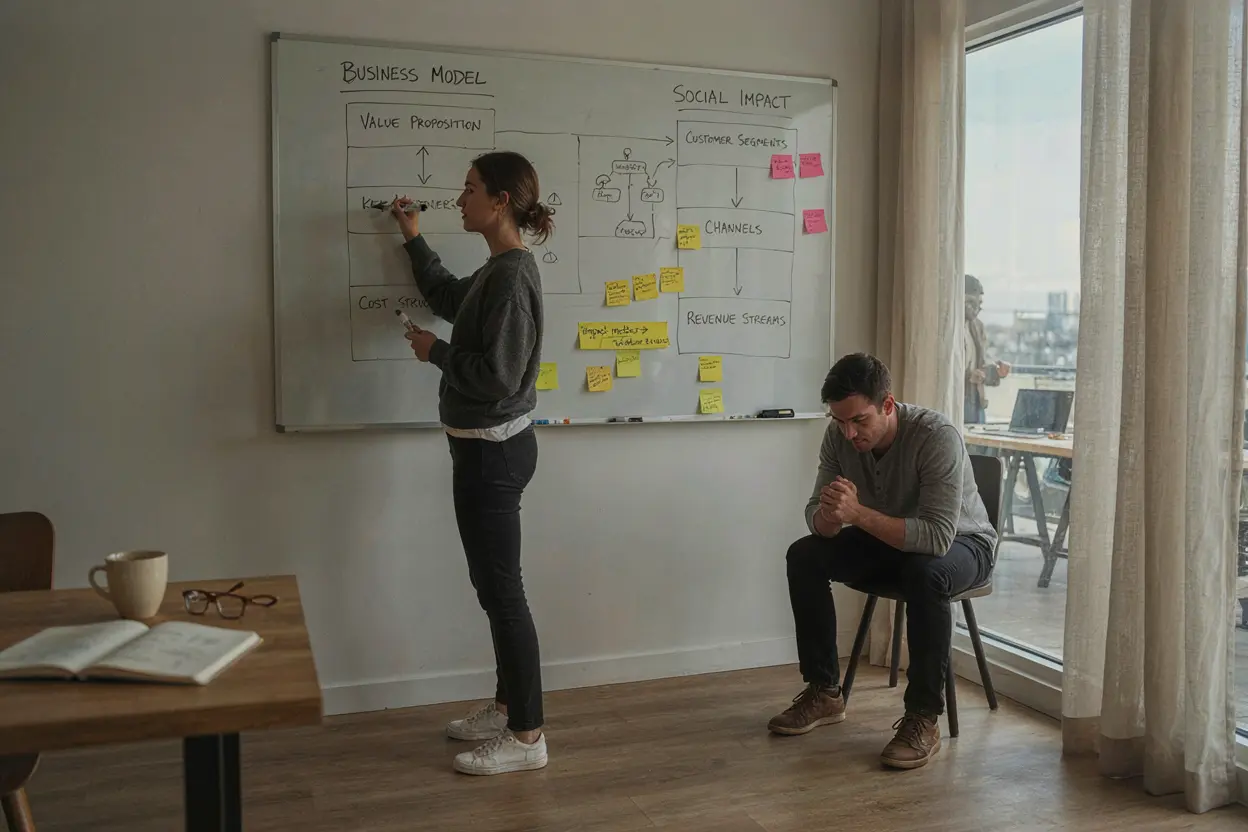
If you’re considering starting a social enterprise, or if your existing business is thinking about embedding a social mission, these five questions will tell you whether the idea has legs.
1. Would the customer buy this without the mission?
If yes, you have a product with a mission advantage. If no, you have a charity with a business veneer. Neither is wrong, but they require fundamentally different funding strategies.
2. Does the social impact scale with revenue?
The best social enterprises create more impact as they sell more. If your impact is fixed regardless of how many customers you serve, the social mission isn’t embedded in the business model. It’s bolted on.
3. Can you articulate the unit economics in one sentence?
“We charge X for Y, which costs us Z to deliver, and the social impact happens as part of delivery.” If you can’t say this simply, the model isn’t clear enough to survive the first year.
4. What happens if the grant funding disappears tomorrow?
If the answer is “we close,” the enterprise isn’t sustainable. Grants should fund growth and experimentation, not core operations. If your operating costs require external subsidy, you have a nonprofit, not a social enterprise.
5. Could someone without your passion run this?
If the enterprise depends on your personal commitment, relationships, or willingness to work below market rate, it’s not a scalable model. It’s a personal project. That’s fine, but be honest about what it is.
What Social Entrepreneurship Is Not
The term gets misused enough that it’s worth being clear about what doesn’t count.
- A regular business that donates to charity is not a social enterprise. It’s a business with a charitable giving programme. That’s commendable but structurally different.
- A company that has a sustainability policy is not necessarily a social enterprise. Reducing waste and carbon footprint is good practice for any business, not evidence of a social mission.
- A nonprofit that earns some revenue is not automatically a social enterprise. A charity shop that sells donated goods is funding a mission, not operating a business where the mission and the model are the same thing.
- Greenwashing is when a company claims social or environmental credentials that aren’t backed by its actual operations. The rise of social entrepreneurship has unfortunately increased the incentive for companies to overstate their impact. The B Corp certification exists partly to counter this.
Frequently Asked Questions
What is social entrepreneurship in simple terms?
Social entrepreneurship is building a business where solving a social problem is the core activity, not a side project. The product or service itself creates social impact, and the revenue from selling it funds the continued delivery of that impact. It’s distinct from a regular business that donates to charity or a nonprofit that earns some income.
What are the main types of social enterprises?
The main structures are: social impact businesses (for-profit companies with an embedded social mission), nonprofit social enterprises (charities that run earned-income activities), benefit corporations (legal structures that require consideration of social and environmental impact alongside profit), and cooperative models (member-owned businesses that serve a community need). Each structure suits different combinations of mission and revenue model.
Why do social enterprises fail?
The same reasons conventional startups fail (running out of money, no market fit, team problems) plus additional challenges specific to the sector: mission creep, the tension between social impact and financial sustainability, dependence on grant funding that doesn’t transition to earned revenue, and founder burnout from trying to run two businesses (a commercial one and a social one) inside a single organisation.
How is social entrepreneurship different from CSR?
Corporate social responsibility is a programme that a traditional business runs alongside its core operations. Social entrepreneurship is a business where the social mission and the core operations are the same thing. CSR is funded from profits. Social enterprise impact is generated through the act of selling. CSR stops when the profits stop. Social enterprise impact stops when the business stops.
Can social enterprises be profitable?
Yes. Profitability is what separates a sustainable social enterprise from a charity that needs constant fundraising. The best social enterprises generate enough revenue to cover their costs, pay competitive salaries, and reinvest in growth, while simultaneously creating measurable social impact. The constraint is that the profit must come from delivering the social mission, not from activities unrelated to it.
The Bottom Line
Social entrepreneurship matters because it offers a model for solving problems that neither pure markets nor pure charity can solve alone. Markets won’t fix problems that don’t have enough paying customers. Charity won’t fix problems that need sustainable revenue to scale. Social enterprises sit in that gap and build businesses that close it.
But the term is only useful if it means something specific. A business that does some good things is not the same as a business built to do good. The difference is in the operating model, not the marketing.
If you’re considering this path, start with the five questions above. If the answers are honest, you’ll know whether you’re building a social enterprise or a regular business with good intentions. Both are worth doing. Just be clear about which one you’re building.