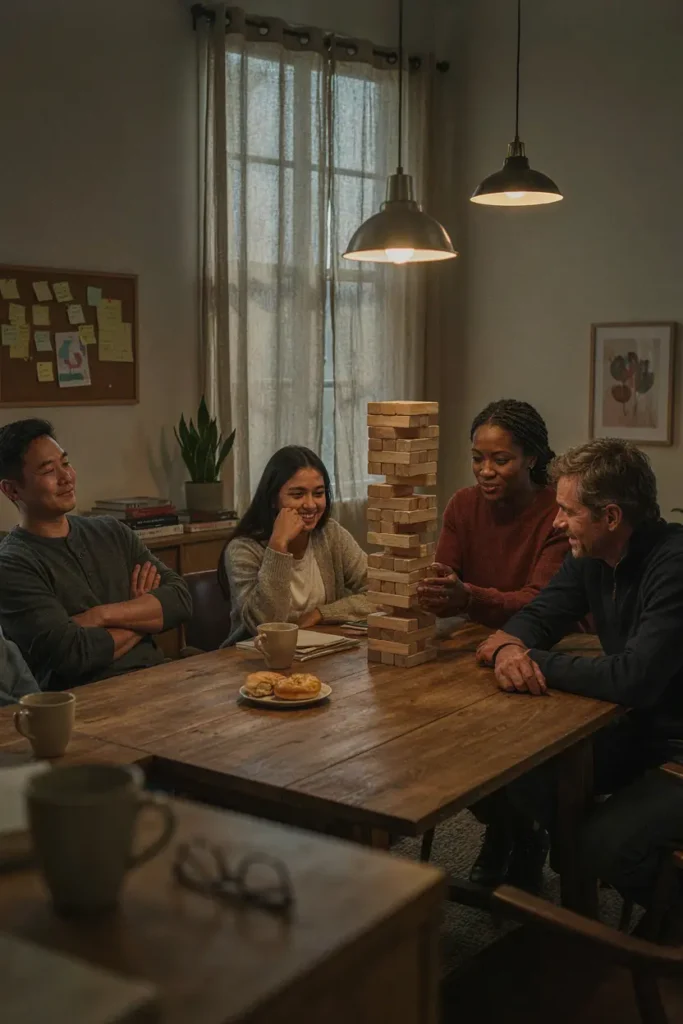
What Is Team Building Jenga?
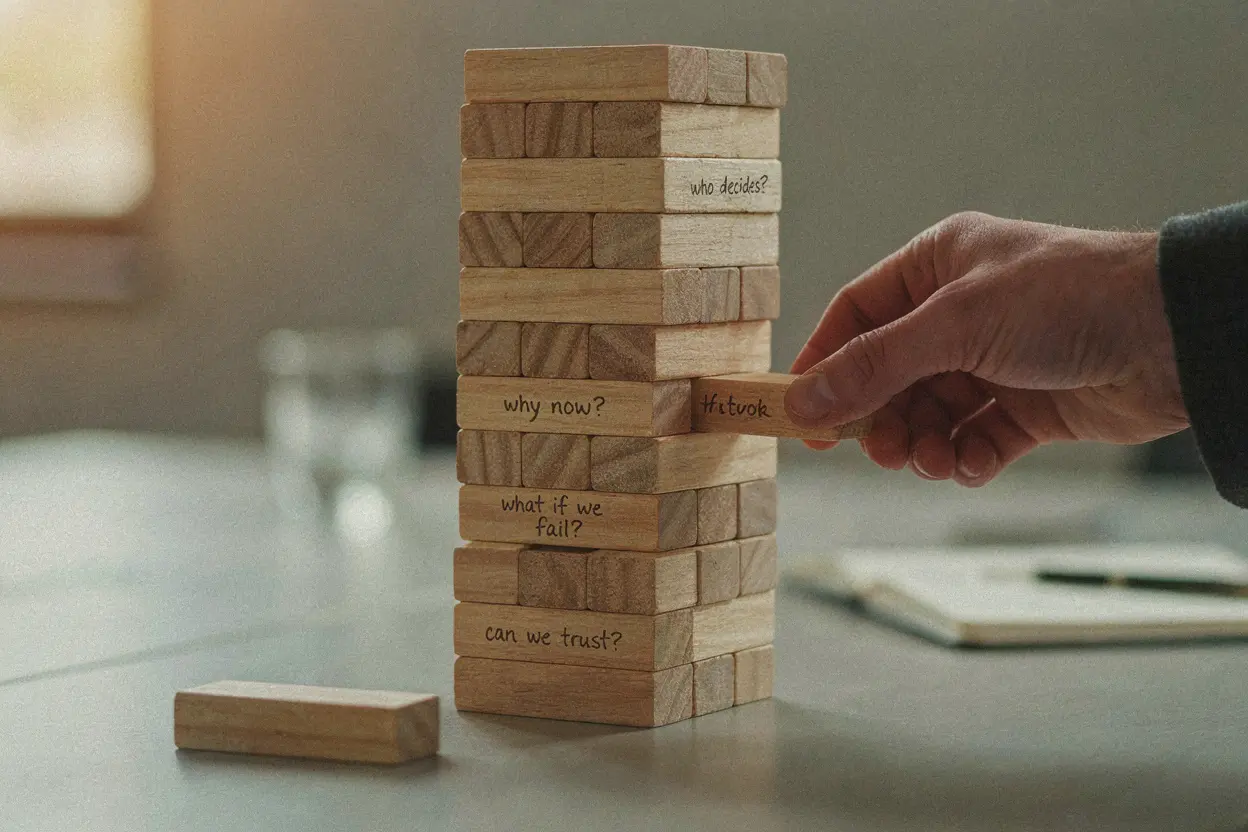
Team building Jenga is the classic block-stacking game adapted for groups by writing questions, challenges, or tasks on each block. When a player pulls a block, they answer the question or complete the challenge before placing it on top. The tower’s growing instability mirrors how teams handle pressure, risk, and shared responsibility.
The game needs almost no setup. A standard Jenga set has 54 blocks. Write something on each one. Put people in groups of four to six. Play. That’s the activity.
What makes it work for team building isn’t the physical game itself. It’s the forced conversation. Every turn requires someone to say something, do something, or decide something in front of their colleagues. The tower falling over is the least interesting part. The interesting part is what people reveal about themselves and how the group responds.
I’ve used this with newly formed teams that barely know each other and with veteran teams that think they have nothing left to learn. It works on both because it lowers people’s guard. Nobody feels threatened by a wooden block game. That’s when the honest answers come out.
54 Questions and Challenges for Your Blocks
Here’s a complete set of prompts for all 54 blocks, numbered 1 through 54. The categories below the list explain which range serves which purpose.
Icebreakers (Blocks 1-15): Low-risk questions for new teams. Work and Collaboration (Blocks 16-30): How people actually experience this team. Problem-Solving and Risk (Blocks 31-42): How the team handles challenges. Challenges and Actions (Blocks 43-54): Things to do, not answer.
- Block 1 — What was your first job and what did you learn from it?
- Block 2 — What’s one thing about your role that most people here don’t know?
- Block 3 — If you could add one thing to the office, what would it be?
- Block 4 — What’s a skill you have that has nothing to do with your job title?
- Block 5 — Describe your ideal workday in three words.
- Block 6 — What’s the best piece of career advice you’ve ever received?
- Block 7 — If you could shadow anyone in this company for a day, who?
- Block 8 — What did you want to be when you were ten years old?
- Block 9 — What’s one thing you’ve done this week that you’re proud of?
- Block 10 — If our team had a theme song, what would it be?
- Block 11 — What’s something you recently learned that surprised you?
- Block 12 — What’s the best meal you’ve had this month?
- Block 13 — Do you work better in the morning or the afternoon?
- Block 14 — What’s one app you can’t live without?
- Block 15 — If you could instantly become an expert in anything, what would it be?
- Block 16 — What’s one thing our team does really well?
- Block 17 — What’s one process we could improve this week?
- Block 18 — When do you feel most productive?
- Block 19 — What’s the biggest time-waster in your typical workday?
- Block 20 — Name a colleague whose working style you admire. What do they do differently?
- Block 21 — What would make our meetings more useful?
- Block 22 — If you could change one thing about how we communicate, what would it be?
- Block 23 — What’s the hardest part of your job that nobody else sees?
- Block 24 — When was the last time you asked for help and were glad you did?
- Block 25 — What’s one thing you wish your manager knew about your day-to-day?
- Block 26 — How do you prefer to receive feedback: written, verbal, or in a meeting?
- Block 27 — What’s a decision our team made recently that you think was right?
- Block 28 — What’s a decision our team made recently that you’re still not sure about?
- Block 29 — If you had to teach the team one thing, what would it be?
- Block 30 — What does “good teamwork” look like to you in one sentence?
- Block 31 — Describe a time you took a risk at work that paid off.
- Block 32 — Describe a time you took a risk at work that didn’t pay off. What did you learn?
- Block 33 — What’s the smartest shortcut you’ve ever found?
- Block 34 — If our team had to solve one problem in the next 30 minutes, what should it be?
- Block 35 — When has the team disagreed and it turned out to be a good thing?
- Block 36 — What’s something we avoid talking about that we shouldn’t?
- Block 37 — If you could undo one decision from the last quarter, what would it be?
- Block 38 — What’s harder: starting something new or finishing something that’s stuck?
- Block 39 — Who on the team would you go to for honest advice? Why them?
- Block 40 — What would you do differently if you knew you couldn’t fail?
- Block 41 — What’s the most useful criticism you’ve ever received?
- Block 42 — If our team were a building, which floor would need the most maintenance?
- Block 43 — Give a genuine compliment to the person on your left.
- Block 44 — Let the group decide which block you should pull next.
- Block 45 — Do your next pull with your non-dominant hand.
- Block 46 — Trade seats with someone across from you.
- Block 47 — Let someone else choose your next block for you.
- Block 48 — Describe the team’s biggest strength in exactly five words.
- Block 49 — Name three people on this team who have helped you and say how.
- Block 50 — Take a 30-second break while everyone else discusses the next move.
- Block 51 — Pull two blocks in one turn (stack them both on top).
- Block 52 — Let the youngest person in the group decide your next move.
- Block 53 — Share one thing you want to accomplish before the end of the year.
- Block 54 — Thank a colleague for something specific they did recently.
How to Mix the Blocks
Don’t put all the deep questions at the top or all the icebreakers at the bottom. Shuffle them. The tower gets more unstable as it grows, and the questions should get more challenging at the same time. Put icebreakers on blocks 1 through 15 (the bottom layers that get pulled first), collaboration questions on 16 through 30, problem-solving on 31 through 42, and physical challenges on 43 through 54 (the top layers that get pulled last when the tower is most precarious).
This way the game’s physical tension and the conversation’s depth increase together. By the time someone’s hand is shaking over a wobbly tower, they’re answering the hard questions.
How to Run a Team Building Jenga Session
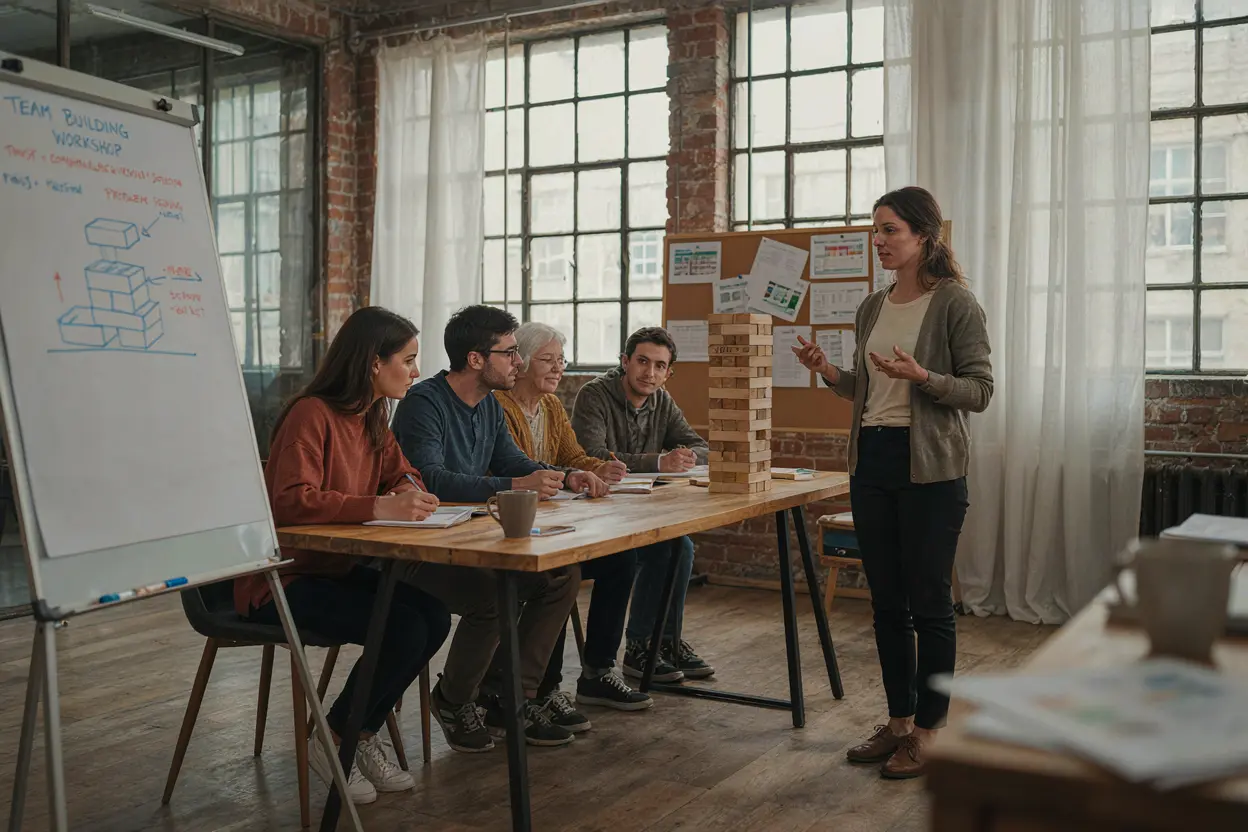
A full session takes 30 to 45 minutes for a group of four to six people. Here’s the step-by-step process from setup to debrief.
Step 1: Prepare the Blocks (before the session)
Write the questions or challenges on each block with a permanent marker or use numbered stickers with a separate question sheet. The sticker method lets you reuse the set with different questions for different sessions. A standard Jenga set costs around £10 to £15. For larger groups, buy multiple sets and run simultaneous games.
Step 2: Set the Frame (2 minutes)
Tell the group: “This isn’t just a game. Each block has a question or challenge. When you pull a block, you answer or do it before you place it on top. There are no wrong answers. And there’s a pass rule: if a question or challenge makes you uncomfortable, you can skip it, no explanation needed. The goal is to have the conversation, not to keep the tower standing.”
That pass rule matters more than it sounds. People who know they can opt out are more likely to engage honestly than people who feel trapped. And the “tower falling is fine” line matters too. If people think the goal is to not knock the tower over, they’ll play it safe and avoid the interesting blocks.
Step 3: Play (20 to 30 minutes)
Standard Jenga rules: pull one block from anywhere except the top completed layer, place it on top. One hand only. The turn ends when the next person touches the tower.
Your role as facilitator during play:
- Watch who talks and who doesn’t. The game naturally draws out quiet people (they have to answer when it’s their turn) and tempers dominators (they can only talk when it’s their turn).
- Note which questions produce the longest discussions. Those are the topics the team actually needs to talk about.
- Don’t intervene. Let the group manage itself. If someone’s answer sparks a debate, let it run. That’s the exercise working.
- If the tower falls, rebuild it and keep going. Don’t declare a “loser.” The game continues until time runs out.
Step 4: Debrief (10 to 15 minutes)
This is where the session earns its time. Without a debrief, people walk away having had a fun half hour. With one, they walk away knowing something about their team.
Questions that work:
- “Which question made you think the hardest? Why?”
- “Was there anything someone said that surprised you?”
- “How did the team’s conversation change as the tower got more unstable?”
- “Did anyone feel pressure to answer quickly because the tower was wobbly? Is that similar to how decisions get made at work?”
- “What came up today that we should keep talking about after this session?”
The last question is the most important. If the Jenga session surfaced something real, capture it and follow up. Nothing kills trust faster than a team building exercise that reveals a problem nobody addresses afterwards.
Variations for Different Team Stages
The same Jenga set can serve different purposes depending on what your team needs. The blocks change, not the game.
| Team Stage | Block Focus | Why |
|---|---|---|
| New team (forming) | Icebreakers and personal questions (80%), light work questions (20%) | People need to know each other before they can disagree productively |
| Storming team | Work and collaboration questions (60%), problem-solving (30%), challenges (10%) | Surface the real issues in a low-stakes setting |
| Established team (norming/performing) | Problem-solving (40%), challenges (30%), personal (30%) | Push past comfort zone; these teams can handle direct questions |
| Remote/hybrid team (in-person day) | Personal questions (50%), work questions (30%), physical challenges (20%) | Maximise the face-to-face time; these people don’t get this often |
| Leadership team | Problem-solving (50%), work questions (30%), challenges (20%) | Leaders need to model vulnerability; harder questions force it |
You can also run themed versions:
- Values Jenga: Write the company’s stated values on blocks. When someone pulls “integrity,” they share a time they saw it practised or violated at work.
- Project retrospective Jenga: Questions reference the specific project the team just finished. “What was the best decision we made on Project X?” “What would you do differently?”
- Onboarding Jenga: For new hires joining an existing team. Blocks mix personal questions with “how things work here” questions that teach culture through conversation rather than a handbook.
Giant Jenga vs. Tabletop Jenga
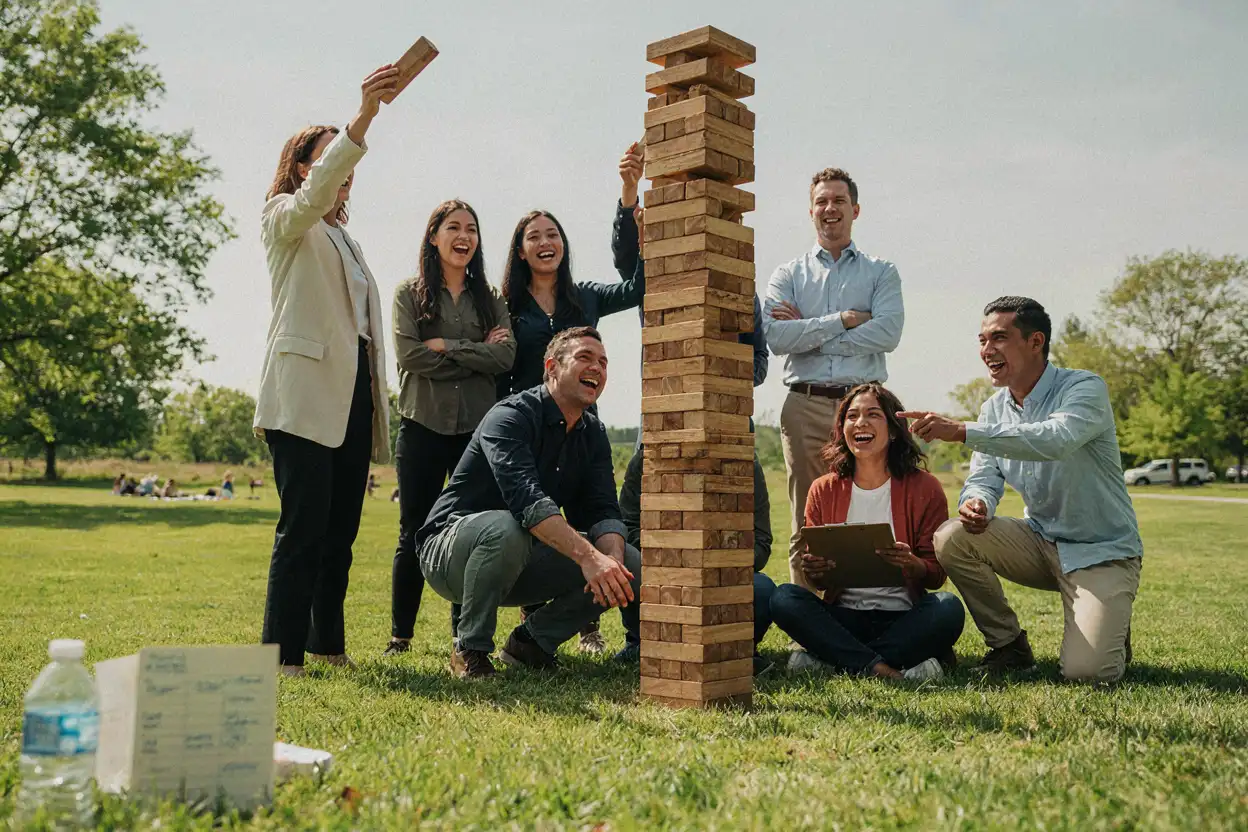
Giant Jenga (blocks the size of bricks, tower up to five feet tall) creates a more physical, visually impressive experience. Tabletop Jenga (the standard set) creates a more intimate, conversation-focused one. Choose based on your goal, not your budget.
| Factor | Tabletop Jenga | Giant Jenga |
|---|---|---|
| Cost | £10–15 per set | £40–100 per set or £50–80 to rent |
| Group size | 4–6 people per set | 6–10 people can gather around one tower |
| Conversation depth | Deeper, quieter, more intimate | Lighter, more spectacle, more laughter |
| Physical element | Minimal, fine motor skills | Significant, whole body, balance, teamwork |
| Writing on blocks | Easy, small text, permanent marker | Harder, need larger text or numbered sticker system |
| Best for | Debriefing, storming, leadership teams | Icebreaking, forming, large group events |
For the question-heavy, conversation-focused version described in this article, tabletop Jenga works better. The smaller scale keeps people close together and the conversation focused. Giant Jenga is better when you want energy and spectacle rather than depth.
Adapting Jenga for Remote Teams

You can’t play physical Jenga over Zoom, but you can replicate the core mechanic: a random prompt generator that forces each person to answer or act in turn. Several free tools do this.
Options that work:
- Virtual Jenga apps: Several free online Jenga games let you assign questions to blocks. Players take turns pulling blocks on a shared screen and answering the revealed question. Search for “virtual Jenga team building” — tools like Virtual Team Building and Let’s Roam offer browser-based versions.
- Random question spinner: Use a tool like Wheel of Names with the 54 questions loaded as entries. Each person spins the wheel, answers the question that lands, then the next person spins. The “tower” element is lost, but the forced conversation remains.
- Numbered blocks with a shared document: Put the 54 questions in a numbered Google Sheet. Use a random number generator to assign each turn. The group watches a shared Jenga tower (one person plays physically on camera) while the assigned person answers the corresponding question.
Remote Jenga works, but it loses the physical tension that makes the in-person version compelling. If your remote team has an occasional in-person day, save Jenga for that. Use other remote-specific activities for the Zoom days.
When Jenga Doesn’t Work
Jenga is a good exercise for many situations but a bad one for some. Knowing when to skip it saves everyone an awkward afternoon.
Skip Jenga when:
- The team is in active conflict. Forced conversation during high tension can make things worse. Use a structured facilitation exercise instead (like the Elephant in the Room session or a formal retrospective).
- Senior leadership is watching. People won’t give honest answers to “what would you change about this team?” if the CEO is sitting at the table. Jenga needs psychological safety to work.
- The team has played it before with the same questions. Once people know the questions, they prepare answers instead of giving honest ones. Switch the questions or use a different exercise.
- You have less than 30 minutes. The game needs time for the tower to get interesting and the conversation to go somewhere. A rushed session produces surface-level answers and no debrief.
One more thing. I’ve seen facilitators try to use Jenga as a “fun” way to deliver serious feedback or announce organisational changes. Don’t. The game works because people lower their guard. Using it as a Trojan horse for bad news destroys the trust that makes it work in the first place.
Frequently Asked Questions
How many people can play team building Jenga?
A standard Jenga set works best with four to six players. With more than six, turns come around too slowly and people disengage between turns. For larger groups, buy multiple sets and run simultaneous games with different question sets. Giant Jenga can accommodate six to ten people around a single tower because the physical spectacle keeps everyone engaged even when it’s not their turn.
What should I write on Jenga blocks for team building?
Write questions, challenges, or prompts that spark conversation relevant to your team’s current stage. For new teams, use personal icebreakers. For established teams, use work-related questions about collaboration, decisions, and challenges. The 54 prompts in this article cover all stages. Use a permanent marker for a dedicated set, or numbered stickers with a separate question sheet so you can change the prompts between sessions.
How long does a team building Jenga session take?
Plan for 30 to 45 minutes total: 2 minutes to set the frame, 20 to 30 minutes of play, and 10 to 15 minutes for the debrief. The debrief is where the actual learning happens, so don’t cut it short. A game that ends with the tower falling and everyone packing up has wasted the exercise.
Is there a competitive version of team building Jenga?
Yes. Give each team their own Jenga set with the same questions. The last team with a standing tower wins, but each team must discuss and agree on every answer before the player places the block. This adds a consensus element that slows the game down and forces conversation. However, competitive Jenga tends to produce shallower answers because teams prioritise speed over honesty. Use it for icebreaking energy, not for surfacing real issues.
Can I use Jenga for virtual team building?
Yes, with adaptations. Virtual Jenga apps replicate the block-pulling mechanic online. A simpler alternative is a random question spinner loaded with your prompts, combined with one person playing a physical Jenga set on camera. The conversation element works remotely, but the physical tension that makes in-person Jenga compelling is harder to replicate. Save the full Jenga experience for in-person days if possible.
The Bottom Line
Team building Jenga works because it’s simple enough that nobody feels threatened and structured enough that everyone has to participate. The tower gives people something to do with their hands while the questions give them something to think about. The combination lowers defences in a way that most team building exercises can’t.
The blocks are the easy part. The questions are what matter. Spend your preparation time choosing the right prompts for your team’s current stage, not shopping for fancy Jenga sets. A £12 set from a toy shop with good questions written on it will outperform a £100 giant Jenga with generic icebreakers every time.
And do the debrief. Always do the debrief. A team building exercise without reflection is just a game.