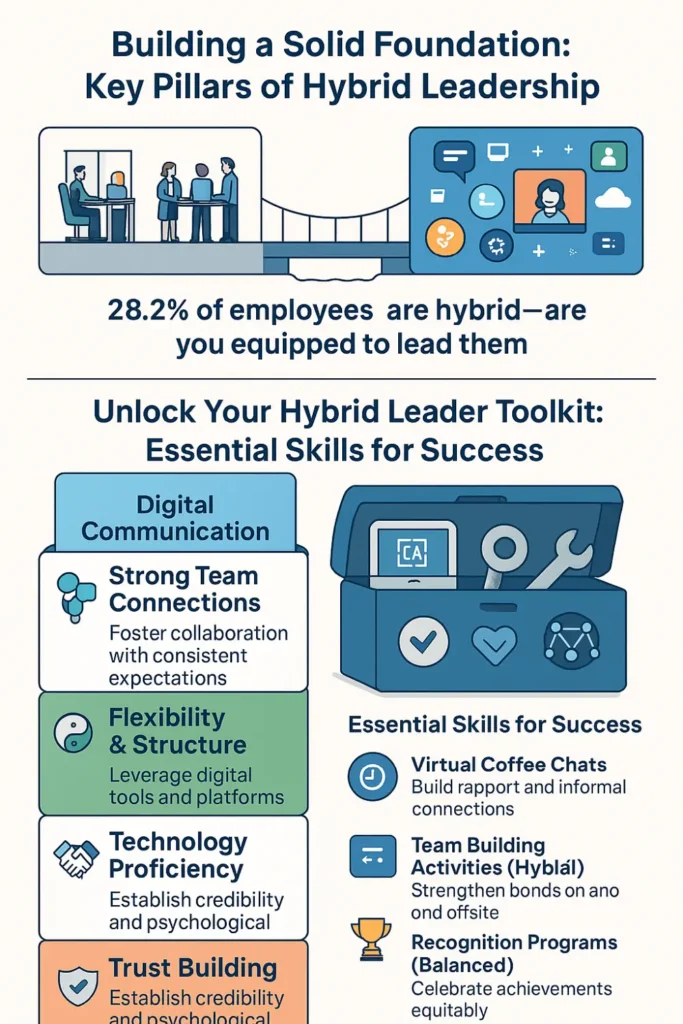
Leading teams across physical and virtual spaces has become a defining challenge of modern leadership. 28.2% of employees now work in hybrid arrangements, creating a need for leaders who can seamlessly bridge both worlds. Effective hybrid leadership requires mastering authentic communication, building trust across distances, and creating inclusive environments that engage both remote and in-office team members.

Building trust becomes more complex when teams are dispersed. Remote workers often feel disconnected while office-based staff receive more face time. Leaders must adapt their communication styles and leverage digital tools to maintain team cohesion and ensure equal engagement across all work settings.
Key Takeaways
- Leaders must balance digital and in-person communication channels to maintain authentic connections with their teams
- Success in hybrid environments demands intentional trust-building and inclusive practices
- Modern leadership effectiveness depends on mastering both traditional and technology-enabled management approaches
What Are the Foundations of Hybrid Leadership?
Hybrid leadership rests on three pillars: clear communication protocols, intentional trust-building, and flexible structures that work across locations. Mastering these foundations lets you lead with authority whether your team is in the office or online.

Effective hybrid leadership requires mastering communication across virtual and physical spaces while building strong team connections. Leaders must balance flexibility with structure to create an environment where all team members can succeed.
Understanding Hybrid Work
Hybrid work combines remote and in-office operations. Teams operate across different locations and time zones, requiring clear coordination and scheduling.
Successful hybrid models need structured communication channels and defined collaboration times. Leaders must establish when teams work remotely versus in-person. According to Buffer’s State of Remote Work report, the most effective hybrid models give employees flexibility while maintaining clear collaboration windows.
Key Components of Hybrid Work:
- Flexible scheduling options
- Digital collaboration tools
- Clear communication protocols
- Defined in-office activities
Leadership Skills in a Hybrid Environment
Inspiring hybrid leaders demonstrate strong emotional intelligence and adaptability. They recognize when to adjust their approach based on the work setting.
Essential Skills:
- Digital communication mastery
- Virtual team management
- Time zone coordination
- Technology proficiency
Leaders must maintain consistent expectations across remote and in-person settings. They should focus on outcomes rather than monitoring work hours.
Building Trust and Engagement
Creating connections in hybrid teams requires intentional relationship building. Regular one-on-one check-ins help maintain personal bonds with team members.
Trust-Building Strategies:
- Virtual coffee chats
- Team building activities
- Recognition programs
- Open feedback channels
Leaders should create equal opportunities for remote and in-office workers to contribute and advance. This prevents location bias and maintains team cohesion. Gallup Workplace research shows that teams with high trust report 40% less burnout and significantly higher productivity.
| Foundation Element | In-Office Focus | Remote Focus |
|---|---|---|
| Communication | Face-to-face meetings, hallway conversations | Video calls, async messaging, documented decisions |
| Trust-building | Observing work habits, informal check-ins | Outcome-based evaluation, virtual social time |
| Performance management | Visible presence, real-time feedback | Results-based metrics, scheduled 1-on-1s |
| Team culture | Shared physical space, spontaneous interactions | Intentional virtual events, digital watercoolers |
How Do You Empower Hybrid Teams Effectively?
Empowering hybrid teams means giving every member equal access to information, decision-making, and growth opportunities regardless of location. Leaders who get this right see higher retention, engagement, and innovation across the entire team.

Leaders who master hybrid team management create strong connections and drive high performance across physical and virtual spaces. Good hybrid leadership combines clear communication, inclusive practices, and strategic engagement methods.
Promoting Inclusivity and Team Culture
Building high-performing hybrid teams requires intentional focus on creating equal experiences for all team members.
Team leaders should schedule regular virtual coffee chats and informal check-ins to maintain social bonds. These casual interactions help remote workers feel connected.
Key Culture-Building Activities:
- Virtual team celebrations and recognition events
- Mixed-format social gatherings that include both office and remote staff
- Shared digital spaces for non-work discussions
- Regular team building exercises adapted for hybrid settings
Effective Management of Distributed Teams
Strong communication skills form the foundation of successful hybrid team management. Leaders must establish clear expectations and performance metrics that work for both in-office and remote team members.
Document sharing, project tracking, and collaboration tools help keep distributed teams aligned. Regular status updates and progress checks prevent information gaps. Owl Labs research found that distributed teams with structured async communication report 30% higher satisfaction than those relying on ad-hoc messaging.
Best Management Practices:
- Set consistent meeting schedules that work across time zones
- Create detailed digital documentation of processes
- Use asynchronous communication when possible
- Maintain regular one-on-one check-ins with all team members
Strategies for Virtual Leadership
Virtual leadership requires specific tools and techniques to engage teams effectively across distances. Leaders should focus on results rather than monitoring work hours or physical presence.
Digital tools enable leaders to maintain team cohesion. Video conferencing, instant messaging, and virtual whiteboards facilitate collaboration and creativity.
Essential Virtual Leadership Skills:
- Active digital presence and accessibility
- Clear written and verbal communication
- Ability to build trust without physical proximity
- Cultural awareness across virtual spaces
Team recognition programs should highlight contributions from both remote and in-office staff equally. This balanced approach strengthens team unity and motivation. For broader strategies on strengthening how teams collaborate, see key strategies for team dynamics and leadership.
How Can Hybrid Teams Boost Collaboration and Productivity?
Hybrid teams thrive when leaders create clear structures for how work gets done, who decides what, and which tools serve which purpose. With the right systems in place, collaboration becomes effortless regardless of where each person sits.

Leaders who excel in hybrid environments create clear structures and processes that enable teams to work together seamlessly across physical and virtual spaces. Strong collaboration tools, communication protocols, and performance tracking systems form the foundation of successful hybrid operations.
Fostering Innovation and Performance
Effective hybrid leadership requires establishing clear performance metrics while maintaining flexibility in how work gets done. Leaders should set outcome-based goals rather than focusing on time spent working.
Daily check-ins help teams stay aligned without micromanaging. These brief meetings keep projects moving forward and address roadblocks quickly.
Team members need access to digital collaboration tools that match their workflow needs. Project management software, virtual whiteboards, and shared document systems enable real-time cooperation.
Strengthening Communication and Collaboration
Successful hybrid collaboration depends on intentional communication practices. Leaders must establish clear channels for different types of interactions.
Key Communication Channels:
- Instant messaging for quick questions
- Video calls for complex discussions
- Email for formal documentation
- Team portals for shared resources
Regular team building activities help maintain strong connections between remote and office-based staff. Virtual coffee chats and hybrid social events create informal bonding opportunities.
Developing Accountability and Ownership
Teams need clear responsibilities and decision-making authority. Leaders should document role expectations and empower team members to take initiative.
Remote management strategies work best when built on trust. Regular feedback sessions help maintain alignment and address concerns promptly.
Accountability Best Practices:
- Set measurable goals
- Track progress transparently
- Celebrate team wins
- Address issues early
| Collaboration Challenge | In-Office Solution | Hybrid Solution |
|---|---|---|
| Information asymmetry | Organic sharing through proximity | Centralized docs + async updates for all |
| Meeting inclusion | Everyone in the same room | Hybrid-ready rooms + remote-first facilitation |
| Spontaneous collaboration | Hallway conversations | Dedicated Slack channels + virtual whiteboards |
| Performance visibility | Managers observe work directly | Outcome-based metrics and transparent dashboards |
How Is Digital Transformation Reshaping Leadership?
Digital tools now determine how leaders communicate decisions, track performance, and build culture. The most effective hybrid leaders combine analytics proficiency with emotional intelligence to guide teams through constant change.
Digital transformation reshapes how leaders guide teams and make decisions. Modern leadership combines technical skills with emotional intelligence to drive success in both virtual and physical workspaces. Deloitte Insights reports that organizations with digitally fluent leaders adapt to change 50% faster than their peers.
Integrating Digital Tools and Analytics
Leaders must master digital platforms for effective decision-making. Data dashboards and collaboration tools provide real-time insights into team performance and project status.
Essential Digital Leadership Tools:
- Performance tracking software
- Team collaboration platforms
- Data visualization tools
- Project management systems
Strategic thinking now requires the ability to interpret data patterns and trends. Leaders combine analytics with human judgment to make informed choices.
Emotional intelligence remains crucial even with digital tools. Leaders must read virtual cues and maintain personal connections through screens. For deeper insight, explore how emotional intelligence drives effective virtual meeting leadership.
Remote Leadership in a Virtual World
Virtual team management demands new approaches to engagement and supervision. Leaders focus on outcomes rather than monitoring work hours.
Key Virtual Leadership Practices:
- Regular video check-ins
- Clear digital communication channels
- Virtual team-building activities
- Recognition through online platforms
Proximity bias presents a challenge when managing hybrid teams. Successful leaders ensure equal opportunities and visibility for remote workers.
Virtual leaders establish structured communication practices. They set clear expectations for response times and meeting participation. To learn how continuous improvement principles strengthen team dynamics in any setting, read about the kaizen philosophy for boosting team dynamics.
| Digital Leadership Skill | Traditional Leaders | Digital-First Leaders |
|---|---|---|
| Data usage | Periodic reports and manual tracking | Real-time dashboards and predictive analytics |
| Communication style | Meeting-heavy, verbal updates | Async-first, documented decisions |
| Performance oversight | Presence-based monitoring | Outcome-based tracking with transparency |
| Change adaptation | Slow, hierarchical approval cycles | Rapid iteration with empowered teams |
Frequently Asked Questions
Leading hybrid teams requires specific skills, tools, and strategies to effectively coordinate both remote and in-person work. Successful hybrid leadership focuses on clear communication, team unity, and equal treatment across all work arrangements.
How can leaders effectively manage remote and in-office teams simultaneously?
Hybrid leaders must develop strong digital competencies to coordinate activities across different work settings. They need to establish consistent check-ins and structured meetings that accommodate both in-person and virtual participants.
Regular performance tracking helps maintain accountability across all team members regardless of location. Leaders should set clear expectations and measurable goals for both remote and office-based staff.
What strategies improve communication in a hybrid team environment?
Digital tools like team chat platforms and virtual meeting spaces create seamless connections between distributed team members. Leaders must select and standardize communication channels for different types of interactions.
Virtual chat rooms and collaborative spaces enable spontaneous discussions and informal exchanges that mirror in-office interactions. Regular video meetings help maintain face-to-face connections with remote team members.
What are the essential components of a successful hybrid work model?
A flexible scheduling system allows teams to coordinate in-office days for collaboration. Clear documentation of processes and decisions keeps everyone aligned regardless of location.
Digital toolkits and resources support remote work capabilities. Strong security protocols protect data and communications across distributed work environments.
How can hybrid leaders overcome common challenges?
Technology barriers and proximity bias are the two biggest challenges hybrid leaders face. Investing in reliable tools, providing equal access to information, and training managers on location-neutral evaluation eliminates both problems systematically.