Have you ever wondered why some small businesses thrive while others struggle to grow? The secret might lie in how leaders adapt their style to different situations. The Situational Leadership Model offers a framework that can help small business owners navigate the challenges of scaling their companies.

By using situational leadership, business owners can adjust their approach based on their team’s needs and the company’s stage of growth. This flexibility allows leaders to provide the right level of support and direction at each step of the scaling process. As a result, they can better motivate their employees and guide their businesses toward success. Mind Tools research confirms that leaders who flex their style see measurably higher team performance.
The situational leadership approach recognizes that there’s no one-size-fits-all solution to leadership. Instead, it encourages leaders to assess each situation and choose the most effective style. This adaptability is crucial for small businesses going through different growth stages, from startup to maturity.
Key Takeaways
- Situational leadership helps business owners adapt their style to different growth stages
- Flexible leadership approaches can improve team motivation and company success
- Assessing each situation allows leaders to choose the most effective leadership style
What Is Situational Leadership?
Situational leadership is a flexible framework where leaders adjust their style based on team readiness and the demands of each situation. There is no single best way to lead — the most effective approach depends on the people you’re leading and the context you’re operating in.

Situational leadership adapts to the needs of team members and business stages. It helps small business owners adjust their approach as their company grows and faces new challenges.
Foundations of Situational Leadership
Situational leadership is based on the idea that no single leadership style works best in all situations. Leaders must change their style to match the readiness and ability of their team members. Paul Hersey and Ken Blanchard developed this approach in the 1960s.
The model looks at two key factors:
- Task behavior – how much guidance a leader gives
- Relationship behavior – how much support a leader offers
By adjusting these behaviors, leaders can better meet the needs of their employees and boost performance. SHRM notes that this adaptability is now considered a core competency for people managers at every level.
The Four Leadership Styles
Situational leadership includes four main styles:
- Telling (S1): High directive, low supportive behavior
- Selling (S2): High directive, high supportive behavior
- Participating (S3): Low directive, high supportive behavior
- Delegating (S4): Low directive, low supportive behavior
Leaders pick the style that best fits their team’s needs. For example, new employees may need more direction (S1), while experienced staff might do better with more freedom (S4).
The Two Behavioral Axes
The situational leadership model uses two axes to show different leadership behaviors:
- Directive Behavior: This involves giving clear instructions and closely watching work.
- Relationship Behavior: This focuses on supporting and encouraging team members.
These behaviors form a grid. Leaders can plot their style on this grid to see where they fall. As teams grow and change, leaders may need to move to different points on the grid.
By mastering these axes, small business owners can lead more effectively as their companies scale and face new challenges.
How Do You Apply Situational Leadership During Business Scaling?
Applying situational leadership during scaling means matching your leadership style to your team’s evolving skill levels and confidence. As your business grows, the right balance of direction and support shifts — staying aware of those shifts keeps performance high.
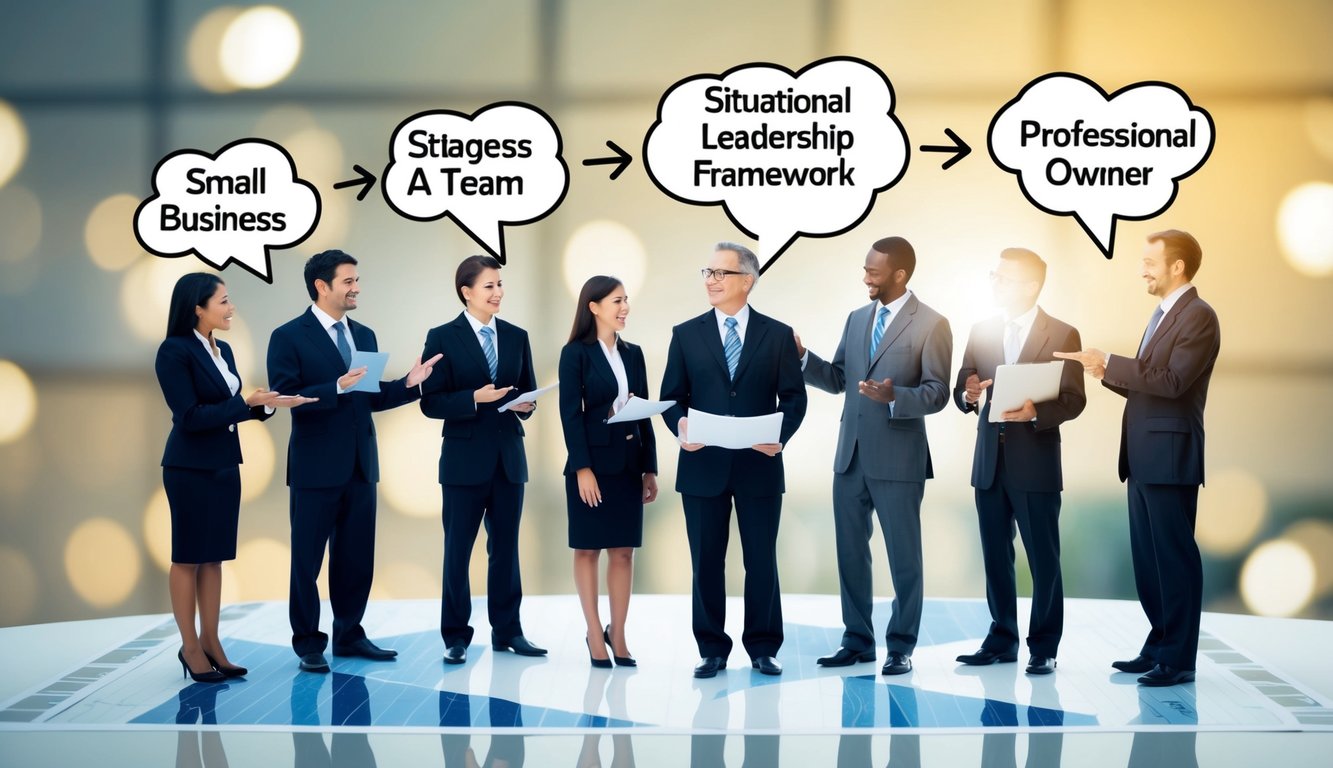
Situational leadership adapts to the needs of a growing business and its team members. This approach helps leaders guide their companies through different growth stages while developing employee skills and readiness.
Assessing Team Maturity and Skill Level
Leaders must evaluate their team’s abilities as the business grows. This assessment looks at both individual and group skills. It also considers how ready employees are to take on new tasks.
A simple skills matrix can help track progress. This tool lists team members and their competencies. Leaders can use it to spot skill gaps and plan training.
Team maturity affects how much direction is needed. New teams often need more guidance. Experienced groups may work well with less oversight.
Appropriate Leadership Strategies for Growth Phases
Different growth phases require different leadership styles. In the early stages, a more hands-on approach works best. Leaders often need to provide clear instructions and close supervision.
As the business expands, the leadership style should evolve. Teams become more skilled and confident. Leaders can then start to delegate more tasks.
During rapid growth, a balance is key. Some areas may need direct management. Others might benefit from a coaching style. Leaders must be flexible and adjust their approach as needed.
Nurturing High Performance and Readiness
Effective leaders focus on developing their team’s skills. They create opportunities for growth and learning. This helps prepare employees for new challenges as the business scales.
Setting clear goals is important. These should align with both company objectives and individual growth plans. Regular check-ins help track progress and offer support.
Mentoring programs can boost performance. Pairing experienced staff with newer team members speeds up skill development. It also builds a culture of continuous learning. Gallup Workplace data shows that teams with strong mentoring report significantly higher engagement and retention.
Feedback and its Role in Leadership
Feedback is crucial for growth and improvement. Leaders should give specific, timely feedback on performance. This helps team members understand their progress and areas for development.
Two-way feedback is valuable. Leaders should also ask for input from their team. This can reveal issues early and improve leadership strategies.
Regular feedback sessions, like monthly one-on-ones, keep communication open. They allow for quick adjustments in leadership style based on changing team needs.
What Leadership Skills Drive Business Success?
Business success hinges on a leader’s ability to develop key competencies, coach their team, and build a culture of trust and innovation. These skills compound over time, creating an environment where both people and the company can scale.

Developing key leadership competencies is crucial for small business owners aiming to scale their operations. Effective leaders adapt their approach, coach team members, and create an environment that fosters innovation and trust.
Key Competencies for Situational Leaders
Situational leadership requires a diverse set of skills to navigate different scenarios. Leaders must be able to assess situations quickly and respond appropriately. Strong communication skills are essential for conveying expectations and providing feedback. Emotional intelligence helps leaders understand and manage team dynamics.
Decision-making abilities are critical. Leaders should be able to analyze problems, weigh options, and make choices that align with business goals. Flexibility allows leaders to adjust their style based on team members’ needs and project requirements.
Time management and prioritization skills help leaders balance multiple responsibilities. They must also develop strategic thinking to plan for long-term success while managing day-to-day operations. Harvard Business Review consistently ranks adaptive decision-making among the top competencies for growing-business leaders.
The Importance of Coaching and Development
Effective leaders invest time in coaching and developing their team members. This approach helps build a skilled workforce and improves employee engagement. Leaders should identify each team member’s strengths and areas for growth.
Regular feedback sessions allow leaders to guide employees’ progress. They can set clear goals and provide resources for skill development. Mentoring programs pair experienced staff with newer employees, fostering knowledge transfer.
Leaders should also focus on their own growth. Attending workshops, reading industry publications, and seeking feedback from peers and mentors can enhance leadership skills. Continuous learning helps leaders stay current with best practices and industry trends.
Fostering a Culture of Innovation and Trust
Innovation thrives in an environment of trust and open communication. Leaders can encourage creativity by welcoming new ideas and rewarding initiative. They should create spaces for brainstorming and collaboration.
Building trust requires consistency and transparency. Leaders should follow through on commitments and communicate openly about company decisions. Recognizing and celebrating team achievements boosts morale and motivation.
Empowering employees to make decisions within their roles promotes a sense of ownership. Leaders can delegate tasks and provide support without micromanaging. This approach helps develop problem-solving skills across the organization. Deloitte Insights research shows that trust-based cultures outperform their peers on both innovation and employee retention.
| Leadership Style | Best Used When | Team Readiness Level | Key Risk if Misapplied |
|---|---|---|---|
| Telling (S1) | New hires or unfamiliar tasks | Low competence, high commitment | Stifles autonomy if used too long |
| Selling (S2) | Team is learning but needs buy-in | Some competence, low commitment | Over-explaining can frustrate capable staff |
| Participating (S3) | Skilled team lacking confidence | High competence, variable commitment | Too hands-off can leave gaps in direction |
| Delegating (S4) | Experienced, self-motivated team | High competence, high commitment | Delegating too early causes errors and disengagement |
Frequently Asked Questions
How do I know which leadership style to use with each team member?
Assess each person’s competence and commitment level on the specific task at hand. Match your style to their readiness — direct for beginners, coach for learners, support for capable but hesitant staff, and delegate for proven performers.
Can situational leadership work for remote or hybrid teams?
Yes, situational leadership translates well to remote and hybrid settings because it focuses on individual needs rather than physical proximity. The key is increasing the frequency of check-ins and using structured feedback to gauge readiness without face-to-face cues.
What happens if a leader uses the wrong style for the situation?
Using a telling style with experienced employees creates resentment and micromanagement, while delegating too early to beginners leads to errors and frustration. The mismatch wastes time and erodes trust, which is why ongoing assessment matters.
How often should leaders reassess their team’s readiness level?
Readiness should be reassessed at every major project milestone, role change, or growth phase — not just during annual reviews. Regular one-on-one check-ins give leaders the real-time data they need to adjust their style before problems develop.